
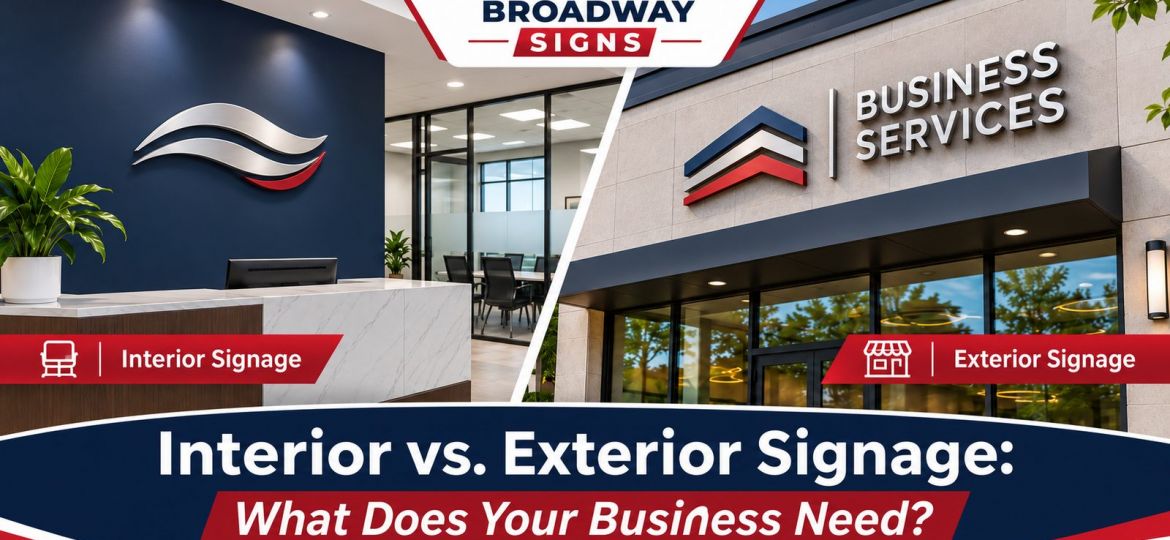
The images in this guide are illustrative signage examples.
A business sign has a job to do. Sometimes that job is helping people notice your location from the street. Sometimes it is confirming that a visitor has arrived at the right office, directing someone through a building, or reinforcing your brand once a customer is already inside.
That is why choosing between interior and exterior signage is not simply about where a sign will be installed. The location affects visibility, materials, scale, mounting, durability, and the type of message the sign needs to communicate. In many cases, the best solution is not choosing one over the other, but planning how both can work together.
In This Guide
- What Is Interior Signage?
- What Is Exterior Signage?
- Interior vs. Exterior Signs: What Is the Difference?
- Where Interior Signage Works Best
- Where Exterior Signage Works Best
- Materials, Visibility, and Durability
- When Your Business Needs Both
- How to Plan the Right Sign Project
- Frequently Asked Questions
Quick Answer
Interior signage is designed for people who are already inside a business or facility. It can identify a lobby, direct visitors, label rooms, add wall graphics, or reinforce a brand at close range. Exterior signage helps people identify and find a business from outside, using storefront signs, window lettering, dimensional letters, and other outdoor sign types. Many businesses benefit from using both as part of one coordinated sign plan.
What Is Interior Signage?
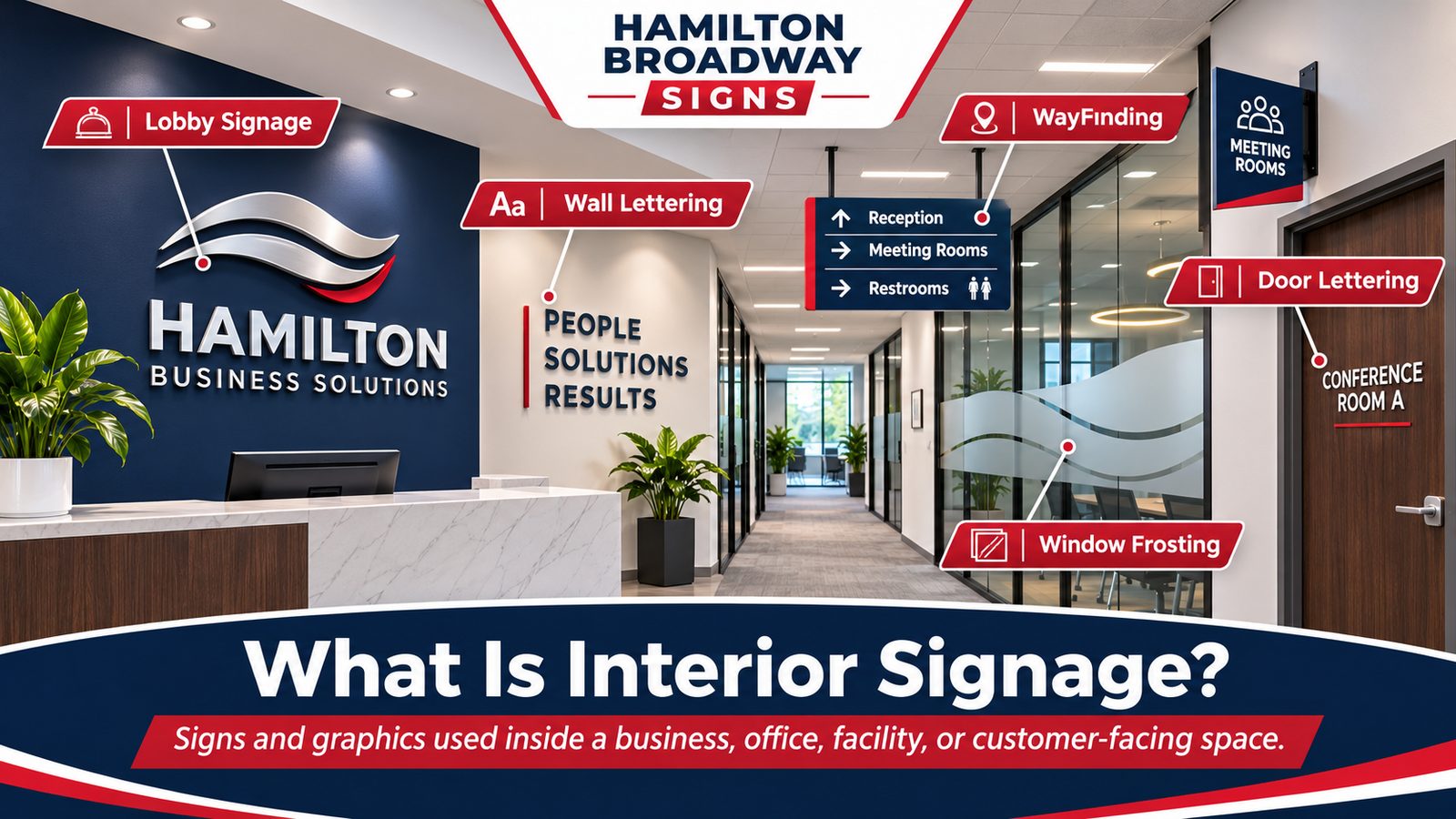
Interior signage covers the signs and graphics used inside a business, office, facility, or customer-facing space. These signs are often viewed at a shorter distance, so they can focus more on detail, finish, navigation, and how the sign fits into the surrounding interior.
Hamilton Broadway Signs offers interior signage options including Lobby Signage, Wall Lettering, WayFinding, Window Frosting/Dusted, Interior Door Lettering, Flag Signs, and Wall Paper/Wraps.
A strong interior sign can do more than display a company name. It can help answer practical questions for a visitor: Where do I check in? Which hallway should I take? Where is a particular department? Am I in the right place?
Interior signs can also support the look and feel of the space. A dimensional lobby sign behind a reception desk, branded wall lettering in a conference area, or frosted window graphics can reinforce identity without requiring the sign to compete with traffic, weather, or long viewing distances.
What Is Exterior Signage?
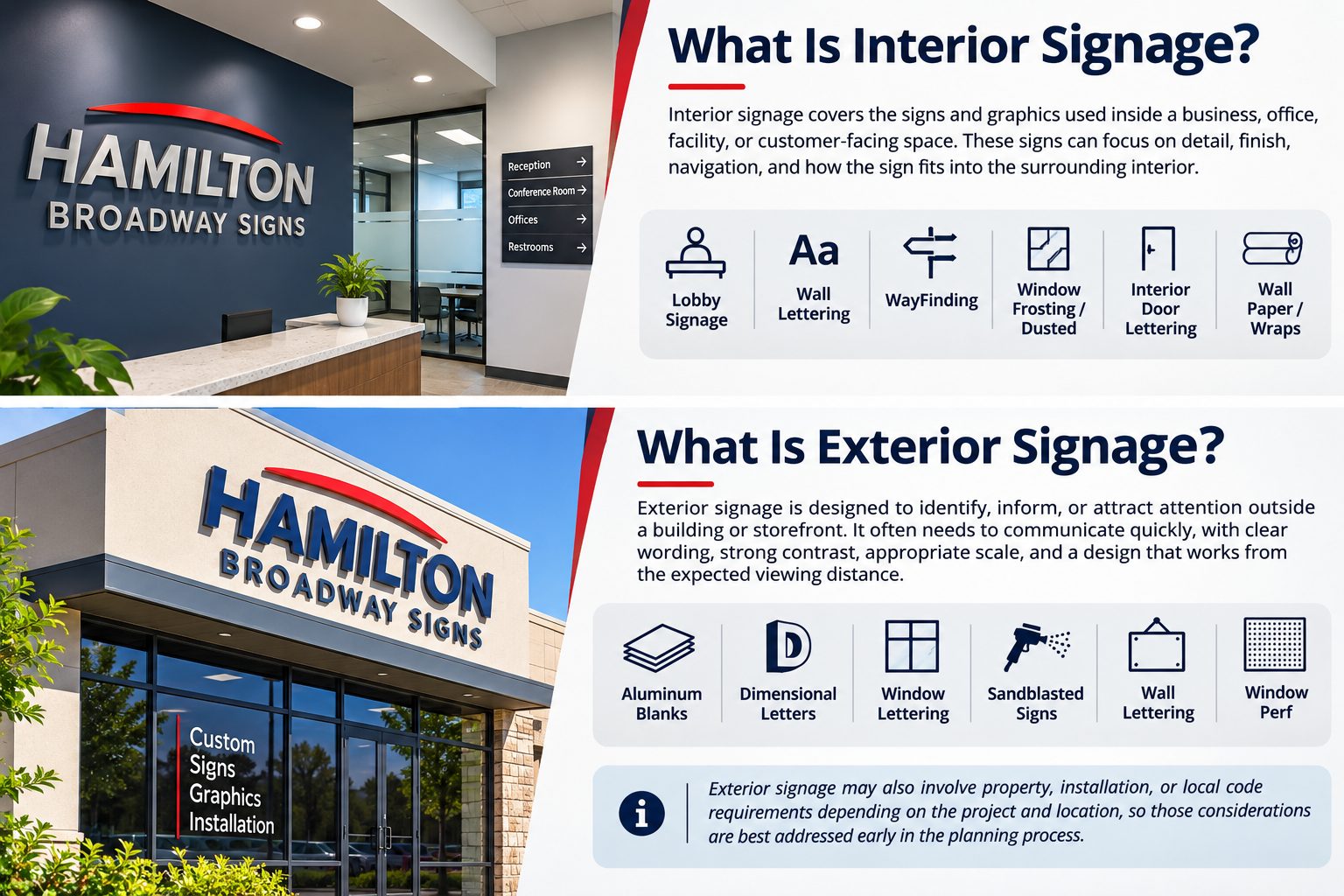
Exterior signage is designed to identify, inform, or attract attention outside a building or storefront. It may be seen from a sidewalk, parking lot, roadway, building entrance, or neighboring property, which means visibility and placement become especially important.
Hamilton Broadway Signs’ outdoor storefront options include Aluminum Blanks, Dimensional Letters, Window Lettering, Sandblasted signs, Wall Lettering, and Window Perf.
Exterior signs often need to communicate quickly. A person passing a storefront may only have a few seconds to recognize the business name, understand what is located there, or confirm the correct entrance. That usually favors clear wording, strong contrast, appropriate scale, and a design that makes sense from the expected viewing distance.
The exterior environment also matters. Mounting surfaces, exposure, location, surrounding architecture, and installation requirements can all influence the final sign solution.
Depending on the project and location, exterior signage may also involve property, installation, or local code requirements. Those considerations are best addressed early in the planning process so the sign concept, mounting approach, and installation plan can be developed together.
Interior vs. Exterior Signs: What Is the Difference?
The clearest difference is the job each type of sign performs.
Interior signs usually support people after they have entered the space. Exterior signs help people recognize, locate, or approach the business before they enter.
A useful way to compare them is to look at six practical factors:
| Factor | Interior Signage | Exterior Signage |
|---|---|---|
| Purpose | Branding, navigation, identification, and customer experience | Business identification, visibility, and helping people find the location |
| Viewing Distance | Usually read from closer range | May need to work from a sidewalk, parking lot, or street |
| Environment | Typically used in a controlled indoor setting | Must account for outdoor exposure and site conditions |
| Message Length | Can sometimes carry more detailed information | Usually benefits from simpler messaging and fast recognition |
| Mounting & Installation | Depends on wall, glass, interior surface, sign weight, and access | Depends on storefront/building conditions, height, mounting area, access, and installation requirements |
| Visual Role | Helps shape the experience inside the space | Shapes how the business is recognized before someone enters |
Neither category is automatically more important. The right priority depends on the customer journey and the problem the sign needs to solve.
Where Interior Signage Works Best
Interior signage is especially useful when a business needs to create a clear, organized experience after someone enters the space.
Lobby and Reception Areas
A lobby sign can establish identity immediately. Dimensional lettering, wall lettering, or other branded elements can help a reception area feel intentional and make it clear that a visitor has reached the correct business.
Offices and Professional Spaces
Interior door lettering, wall signs, and wayfinding can help visitors move through offices, shared workspaces, medical facilities, educational spaces, and other multi-room environments.
Retail and Customer-Facing Areas
Wall graphics, window frosting, branded graphics, and directional signs can support both presentation and function. The goal is not to fill every surface with messaging, but to use signage where it helps customers understand the space.
Hallways and Navigation Points
Wayfinding signs are most useful where a visitor has to make a decision: turn left or right, find a department, locate a room, or move between areas.
When planning interior signage, think about what a first-time visitor sees from the entrance and where uncertainty is most likely to occur. Those moments are often the best places for signs to add value.
Where Exterior Signage Works Best
Exterior signage becomes important anywhere a business needs to be recognized before a customer enters.
Storefront Identification
A storefront sign should make the business easy to identify and should work with the building rather than feeling disconnected from it. Depending on the project, dimensional letters, wall lettering, window lettering, or other exterior sign formats may be appropriate.
Windows and Glass
Window lettering and window graphics can provide business identification or supporting information without requiring a separate freestanding structure. The amount of information should remain easy to understand from the expected viewing distance.
Building and Entry Areas
Exterior signs can help confirm that visitors have reached the correct location, especially in shared commercial properties or buildings with multiple entrances.
Short-Term Exterior Needs
Not every outdoor message needs to be permanent. Banners, A-frames, and other temporary sign types can support events, promotions, directions, or short-term business needs when a permanent sign would not make sense.
The best exterior signage starts with the site. Before choosing a sign type, look at the building, approach routes, sightlines, mounting area, nearby visual clutter, and how people actually arrive at the business.
Materials, Visibility, and Durability
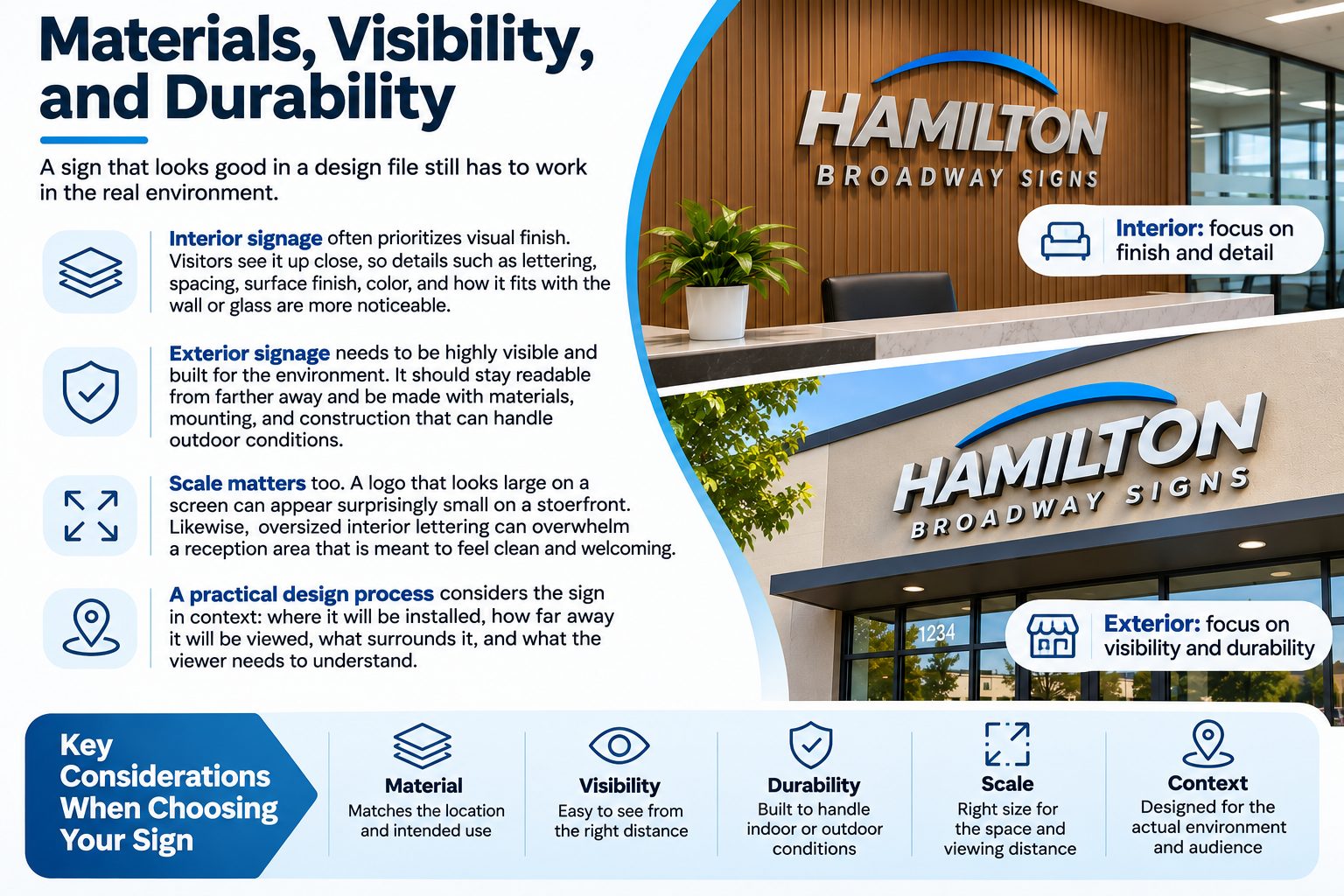
A sign that looks good in a design file still has to work in the real environment.
For interior signage, the visual finish may be one of the biggest priorities. Visitors may see the sign from only a few feet away, so details such as lettering, spacing, surface finish, color, and how the sign interacts with the wall or glass become noticeable.
For exterior signage, visibility and site exposure carry more weight. The sign may need to stay readable from farther away and remain appropriate for outdoor conditions. The selected material, mounting method, and construction should match the intended location rather than simply copying an interior sign format.
This is also where scale matters. A logo that looks large on a computer screen can appear surprisingly small on a storefront. Likewise, oversized interior lettering can overwhelm a reception area that is meant to feel clean and welcoming.
A practical design process considers the sign in context: where it will be installed, how far away it will be viewed, what surrounds it, and what the viewer needs to understand.
When Your Business Needs Both
For many businesses, interior and exterior signage solve different parts of the same customer journey.
Imagine a customer arriving for the first time.
The exterior sign helps them recognize the building. Window or storefront graphics confirm the business. Once inside, a lobby sign reinforces the brand. Wayfinding directs them to the correct room or department. Additional signs provide information where it is needed.
When those pieces are planned together, the experience feels more consistent.
That does not mean every sign has to use the same material or construction. An exterior dimensional-letter sign, an interior lobby sign, and a set of directional signs can still feel connected through consistent colors, typography, logo treatment, and overall design choices.
This coordinated approach is particularly useful for businesses with more than one customer touchpoint, multiple rooms, a large facility, or a brand that needs to carry from the storefront into the interior.
How to Plan the Right Sign Project
Start with the job, not the product.
Before deciding that you need a wall sign, dimensional letters, window graphics, or another specific format, answer a few basic questions:
- Where will the sign be installed?
- Who needs to see it?
- How far away will they be?
- What should they understand within the first few seconds?
- Is the sign permanent, temporary, or likely to change?
- What wall, window, storefront, or mounting surface is available?
- Does the sign need to work with other signs already on the property?
From there, the sign type becomes easier to narrow down.
If you already have a logo or concept, Hamilton Broadway Signs’ design team can help translate it into a workable sign application. If the sign also requires professional installation, the installation plan should be considered before production rather than treated as an afterthought.
The goal is to create a sign that works in its actual setting—not just one that looks good on a proof.
Need Help Choosing the Right Sign for Your Business?
If you are planning new interior signage, updating a storefront, or trying to coordinate signs throughout your business, Hamilton Broadway Signs can help you explore the options.
Share the location, sign purpose, approximate size, available artwork, and any photos of the space or storefront. That gives the team a practical starting point for discussing design, production, and installation.
Frequently Asked Questions
What is the main difference between interior and exterior signage?
Interior signage is primarily designed for people who are already inside a space, while exterior signage helps people identify and locate a business from outside. The viewing distance, environment, mounting, materials, and message often differ as a result.
Can dimensional letters be used indoors and outdoors?
Yes. Hamilton Broadway Signs lists dimensional letters as an outdoor storefront option and also uses dimensional lettering as part of interior lobby identity. The appropriate material, construction, size, and installation depend on where the letters will be used.
What types of interior signs does Hamilton Broadway Signs offer?
Hamilton Broadway Signs’ indoor signage options include Lobby Signage, Window Frosting/Dusted, Interior Door Lettering, WayFinding, Wall Lettering, Flag Signs, and Wall Paper/Wraps.
What types of exterior storefront signs are available?
Hamilton Broadway Signs lists outdoor storefront options including Aluminum Blanks, Dimensional Letters, Window Lettering, Sandblasted signs, Wall Lettering, and Window Perf.
Should a business plan interior and exterior signs together?
It can be helpful when both signs are part of the same customer experience. Planning them together makes it easier to keep logos, colors, typography, and visual direction consistent while allowing each sign to be designed for its specific location and purpose.
Can Hamilton Broadway Signs help with design and installation?
Yes. Hamilton Broadway Signs provides design and installation services in addition to sign production. The design team can help develop or refine artwork for a sign project, while the installation team handles a range of interior and exterior sign installations.